 AGENCY


Best overall: Trainual. Best for collaborative training: 360Learning. Best for formal courses: TalentLMS. Best for onboarding workflows: Process Street. Best for documentation-first onboarding: Notion. The best onboarding platforms for agency teams in 2026 match the work you need new hires to perform—not just the content you want them to read.
- Trainual is the default pick for agency teams turning repeatable processes into assigned onboarding and training.
- 360Learning suits collaborative learning; TalentLMS suits structured courses; Process Street suits repeatable onboarding workflows.
- Notion suits documentation-first onboarding, but reading an SOP does not prove someone can execute it.
- Agency Builders Membership supports agency owners through coaching and masterminds; it is not an onboarding platform.
Why this matters
Your agency cannot scale if every new hire needs the founder to explain how work gets done. Training needs to transfer judgment, standards, and ownership—not create another folder of videos nobody maintains.
An onboarding platform gives that process a home. It does not decide what good work looks like. Before choosing software, define the client deliverables, approval rules, and handoffs that a new teammate must understand.
Agency Builders Membership offers coaching, masterminds, and events for agency owners. That is a different job from onboarding software: owner support belongs alongside your operating systems, not in place of them.
What makes the best onboarding platforms for agency teams?
Use these criteria to evaluate your 2026 shortlist. A polished course builder is not enough if your delivery team cannot find the current process during a client deadline.
- Role relevance: Can you organize learning around what an account manager, designer, strategist, or delivery lead actually does?
- Execution checks: Can you check understanding or route work for review instead of treating page views as competence?
- Content ownership: Can you assign responsibility for updating training when a process changes?
- Delivery fit: Does the platform support courses, reference documentation, or workflow execution—the format your team needs?
- Manager visibility: Can a manager see what has been assigned, completed, or left unfinished?
- Maintenance burden: Can your team keep the material useful without turning training administration into another full-time project?
Choose the platform around the bottleneck. If people cannot find instructions, start with documentation. If they read instructions but miss steps, focus on workflow. If they need to build and demonstrate knowledge, focus on training.
Best agency onboarding platforms at a glance
This 2026 comparison separates the options by their primary use case. The limitations describe the management work each approach still leaves with your agency.
| Platform | Best for | Standout feature | Key limitation |
|---|---|---|---|
| Trainual | Repeatable role-based onboarding | Process documentation combined with assigned training | Your team still has to define and maintain the processes |
| 360Learning | Collaborative learning | Collaborative course creation and learner feedback | Participation needs active ownership and review |
| TalentLMS | Structured course delivery | Courses, assessments, and learning administration | Course completion still needs a connection to real work |
| Process Street | Repeatable onboarding workflows | Workflow runs with tasks, forms, and approvals | A completed checklist is not a demonstration of judgment |
| Notion | Documentation-first onboarding | Connected pages, databases, and templates | Your team must design its own learning and review structure |
These platforms are not interchangeable. A searchable handbook, an assigned course, and an onboarding checklist solve different problems—even when all contain the same instructions.
1. Trainual: best agency onboarding platform for repeatable training
Trainual combines business documentation with employee training. You can organize processes into training content, assign that content, and use tests to check understanding.
That makes Trainual a practical default when your agency already has repeatable services but onboarding still depends on whoever has time to explain them. In 2026, prioritize the processes that affect client delivery: brief intake, production standards, review, and handoff.
Trainual pros:
- Brings documented processes and training into the same system.
- Supports assigned learning rather than relying only on self-directed reading.
- Includes testing to help check whether instructions were understood.
Trainual cons:
- Unclear processes remain unclear when moved into training software.
- Process owners still need to maintain material as delivery changes.
Best for: Agencies that want consistent onboarding across defined roles and repeatable services.
A good starting point is one role with a clear output. Document what that teammate receives, what they produce, how work is reviewed, and when they escalate a problem. Then build training around those decisions.
Do not upload your entire file archive and call it onboarding. A new hire needs a learning path, not a storage migration.
Verdict: Buy Trainual when your priority is turning repeatable agency processes into assigned training.
2. 360Learning: best agency training platform for shared expertise
360Learning is a collaborative learning platform. It supports course creation, learner feedback, and contributions from people with subject expertise.
The fit is strongest when knowledge sits across your agency rather than with one trainer. Your creative lead understands critique; your account lead understands client communication; your strategist understands the reasoning behind recommendations.
360Learning pros:
- Supports contributions from the people who know the work.
- Gives learners ways to provide feedback on training content.
- Supports structured learning without making one person the sole author.
360Learning cons:
- Expert participation needs time and clear responsibility.
- Contributions need review so different authors do not teach conflicting standards.
Best for: Agencies building training from expertise distributed across disciplines.
Keep ownership explicit. The person who contributes a lesson is not automatically the person accountable for the agency's final standard. Name a reviewer for each subject and resolve disagreements before new hires inherit them.
In 2026, use collaborative training to capture the reasoning behind work, not just the sequence of clicks. Explain why a creative direction was rejected, what makes a client brief usable, and when a strategist should challenge an assumption.
Verdict: Buy 360Learning when shared expertise is the core of your training model.
3. TalentLMS: best agency training platform for structured courses
TalentLMS is a learning management system for delivering courses and tracking learning. It includes course-building tools, assessments, and administrative features for organizing training.
Choose this approach when you need a defined curriculum rather than a loose collection of reference pages. It gives managers a structure for assigning learning and checking progress.
TalentLMS pros:
- Organizes training into courses with a defined learning structure.
- Supports assessments alongside instructional content.
- Provides learning administration and progress tracking.
TalentLMS cons:
- Someone still has to turn operational knowledge into useful lessons.
- Assessment results need practical follow-up before you assign independent client work.
Best for: Agencies delivering a consistent curriculum across roles or teams.
Build courses around outcomes. A lesson on client communication should help someone write a clear update, identify a scope issue, or explain a delay—not merely remember your preferred email format.
For your 2026 training plan, separate foundational knowledge from role-specific execution. Everyone needs context about how the agency works. Not everyone needs the same depth of production training.
Verdict: Buy TalentLMS when structured courses and learning administration are the priority.
4. Process Street: best agency onboarding platform for workflows
Process Street focuses on recurring workflows. Its workflow runs can contain tasks, forms, and approvals, making it useful for coordinating the actions involved in onboarding.
This is the right category when your problem is missed handoffs rather than missing lessons. A hiring manager, operations lead, and new teammate can each have work to complete before onboarding is finished.
Process Street pros:
- Turns onboarding into a repeatable sequence of assigned actions.
- Supports forms for collecting information during a workflow.
- Uses approvals to make review part of the process.
Process Street cons:
- Workflow completion alone does not show that someone understands the work.
- Detailed workflows need revision when responsibilities or delivery steps change.
Best for: Agencies that need reliable onboarding coordination and repeatable execution.
Keep administrative tasks separate from skill checks. Setting up access and acknowledging a policy are not the same as producing an acceptable client deliverable.
Use workflow checkpoints to bring those pieces together without confusing them. A manager can confirm that setup is complete, then review a sample task before approving independent work.
Verdict: Buy Process Street when the main problem is inconsistent onboarding execution.
5. Notion: best agency onboarding platform for documentation-first teams
Notion provides pages, databases, and templates for organizing information. You can use it to build an agency handbook, role guides, process references, and an onboarding workspace.
It is a strong starting point when the immediate problem is scattered knowledge. Treat it as a documentation system first, then design the learning path and manager reviews around it.
Notion pros:
- Connects reference pages with databases and related information.
- Supports reusable templates for consistent documentation.
- Lets you organize onboarding alongside working knowledge.
Notion cons:
- Your team must design the assignment and review structure.
- Flexible pages need naming rules and ownership to remain easy to use.
Best for: Agencies that need a central knowledge base before formalizing training.
Keep each process page practical: purpose, owner, inputs, steps, expected output, and escalation rules. Link supporting material only when it helps someone execute the task.
Do not mistake a tidy workspace for a trained team. A new hire can read every page and still need feedback on their first deliverable.
Verdict: Buy Notion when documentation is the bottleneck; hold if your immediate need is formal learning administration.
How we ranked these platforms
The ranking follows the criteria above: role relevance, execution checks, content ownership, delivery fit, manager visibility, and maintenance burden. It is a fit-based buying guide, not a claim of hands-on comparative testing.
Trainual takes the default position because it combines process documentation with assigned training. The remaining options earn distinct slots: collaborative learning, course delivery, workflow coordination, and reference documentation.
No platform receives a blanket recommendation. Your agency's operating problem decides the winner.
Turn the platform into a working onboarding system
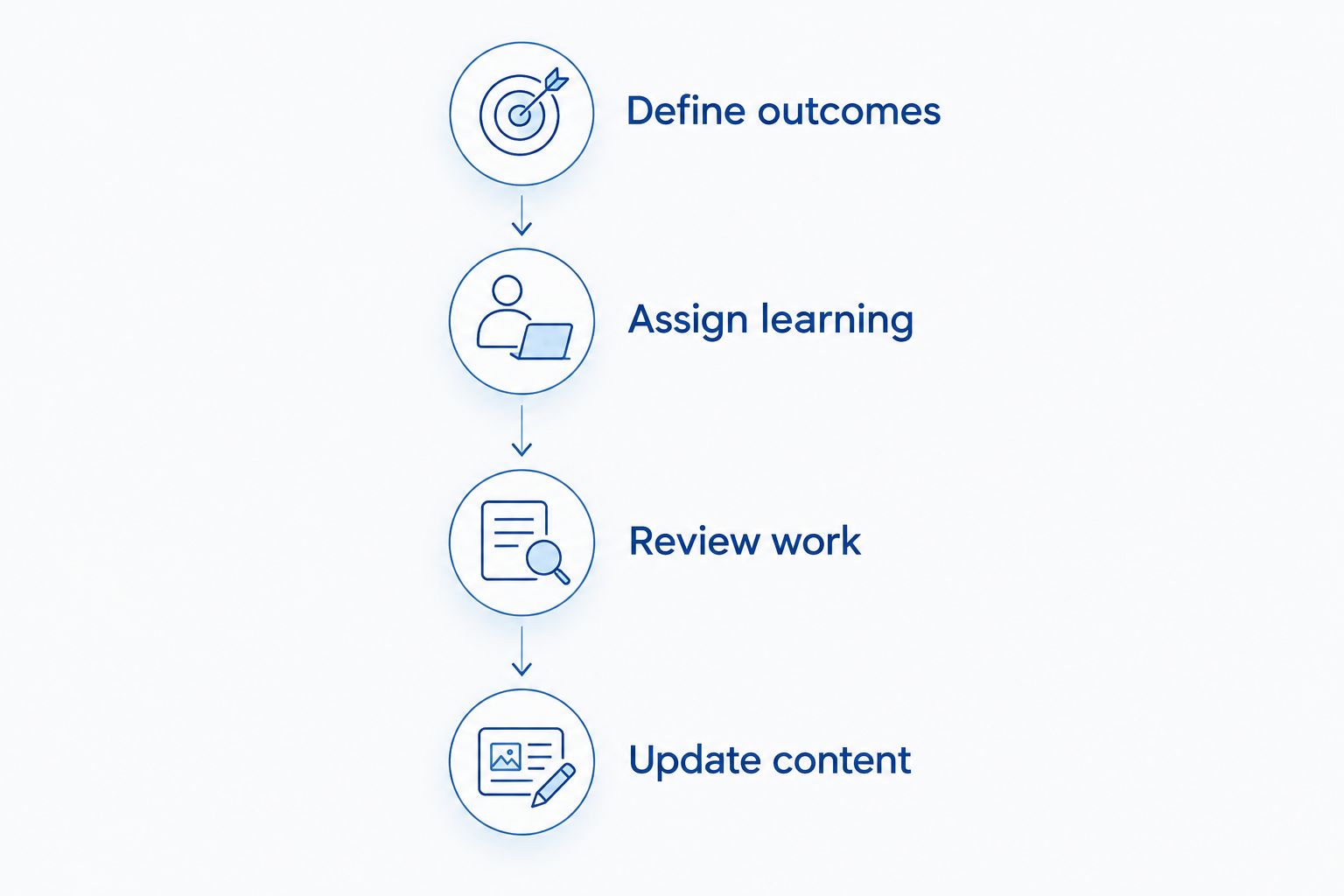
Start with one role before expanding across the agency. A useful onboarding path connects instructions to reviewed work; software is where you organize that path.
Define outcomes
Write down what the teammate must handle without founder intervention. Use actual responsibilities: prepare a brief, complete a review, communicate a scope change, or hand off approved work.
Assign learning
Give each outcome the instructions it needs. Separate required lessons from reference material so the new hire knows what to complete and what to consult later.
Review work
Use a sample task or supervised deliverable to check execution. Review against the same standards you expect on client work, then explain the corrections.
Update content
When a question exposes a gap, fix the source material. Repeated explanations are a signal that the process or training needs revision—not that the founder should keep answering faster.
Agency Builders Membership's agency-owner coaching and masterminds address a different layer: support for the owner building the business. Keep that distinction clear while selecting onboarding platforms. Owner support does not replace role-specific training, and training software does not replace management.
Which agency onboarding platform should you choose?
Choose Trainual if you need a default for repeatable agency onboarding. Choose 360Learning for collaborative learning, TalentLMS for formal courses, Process Street for workflow coordination, or Notion for a documentation-first starting point.
Before committing, build a representative onboarding path in the platform you are evaluating. Include instructions, an assignment, a practical review, and a content update. That exercise exposes whether the system fits your work better than a feature checklist does.
For agency-owner coaching and masterminds rather than onboarding software, Agency Builders Membership is the relevant option. Do not ask a membership community to perform an LMS's job—or an LMS to solve owner isolation.
Build the agency beyond yourself
Explore membership, coaching, masterminds, and events for agency owners.
FAQ
What's the best onboarding platform for agency teams in 2026?
Trainual is the default recommendation for agency teams turning repeatable processes into assigned onboarding and training. Choose a different platform when collaborative learning, formal courses, workflow coordination, or documentation is your primary need.
Is Notion enough for onboarding an agency team?
Notion is enough for a documentation-first onboarding system when managers provide the learning path and practical reviews. A knowledge base alone does not demonstrate that a new hire can perform client work.
Is Trainual better than TalentLMS for an agency?
Trainual is the better fit for process-centered onboarding; TalentLMS is the better fit for structured course delivery. Decide whether your main asset is an operating playbook or a curriculum.
Should an agency use Process Street or an LMS?
Use Process Street for repeatable onboarding actions and approvals; use an LMS for courses and assessments. Keep administrative completion separate from evidence that a teammate can execute the work.
What's the best platform for training created by agency leads?
360Learning is the collaborative-learning pick for training built with subject experts. Assign reviewers so contributions from different leads teach consistent agency standards.
What should an agency include in employee onboarding?
Agency onboarding should cover role outcomes, delivery standards, handoffs, client communication, and escalation rules. Add practical work review before giving a new teammate independent responsibility.
Is Agency Builders Membership an onboarding platform?
Agency Builders Membership is a paid community offering coaching, masterminds, and in-person retreats for digital and creative agency owners. It supports owners rather than serving as employee onboarding software.
One last thing
Your first training asset should be the task you keep rescuing—not the welcome presentation. Pick the recurring handoff, review, or client conversation that pulls you back into delivery.
Document the decision rules. Assign the learning. Review the work. That is how you make onboarding useful to the business instead of merely complete.