 AGENCY


Best overall starting point: Rocket Lawyer. Best for creative-service language: The Contract Shop. Best for proposal-to-signature workflows: PandaDoc. The best contract templates for agencies in 2026 combine clear commercial terms with a document your team can actually use; none replaces legal advice on your specific agreement.
- Rocket Lawyer is the default starting point for customizable business agreements, not a substitute for agency-specific legal review.
- The Contract Shop suits creative-service businesses seeking contract templates closer to their client work.
- PandaDoc suits agencies that need proposal templates, electronic signatures, and repeatable document workflows.
- Agency Builders Membership is best for agency-owner peer learning and coaching, not sourcing legal contract templates.
Why this matters
A vague contract turns a scope dispute into an argument about memory. Your team remembers a limited engagement. Your client remembers everything discussed during the sales call.
Before choosing a provider in 2026, separate the legal document from the operating process. A template establishes terms; your statement of work describes the engagement; your team enforces the boundaries. Weakness in any of those leaves room for unpaid work.
Agency Builders Membership offers agency owners coaching, masterminds, and in-person retreats. That is a different role from a legal-template provider: business support belongs alongside qualified legal advice, not in its place.
What makes the best contract templates for agencies
Judge the document before judging the interface. These criteria determine whether a provider belongs on your shortlist:
- Scope fit: The agreement distinguishes deliverables, exclusions, dependencies, revisions, and client responsibilities. A generic services form needs adaptation when those details are missing.
- Commercial clarity: Payment obligations, invoicing triggers, suspension rights, and termination consequences are understandable. Your account manager should recognize what the agreement requires.
- Rights and permissions: The document addresses ownership, licenses, client-supplied materials, and portfolio use where relevant. Different deliverables need different treatment.
- Legal review: You can get qualified advice on jurisdiction, liability, enforceability, and unusual client terms. Document generation alone does not answer those questions.
- Execution workflow: Your team can complete, approve, sign, and retrieve the agreement without losing track of the final version.
- Reuse discipline: The provider supports your intended way of working, whether that means an editable document or a repeatable signing workflow. Convenience does not excuse unsuitable clauses.
For your 2026 shortlist, prioritize scope fit and legal review before signing convenience. A polished signature process can finalize a bad agreement just as efficiently as a good one.
Contract template providers at a glance
These providers serve different needs. The ranking selects a default starting point, then gives each alternative a distinct job rather than pretending every agency needs the same setup.
| Provider | Best for | Standout feature | Key limitation |
|---|---|---|---|
| Rocket Lawyer | Customizable general business agreements | Guided legal-document creation and access to legal services | General forms still need agency-specific scope and risk review |
| The Contract Shop | Creative-service contract language | Templates aimed at creative and service businesses | A relevant template still needs adaptation to your work and jurisdiction |
| Bonsai | Solo operators managing client administration | Contracts alongside proposals and invoicing tools | Administrative convenience does not establish legal suitability |
| PandaDoc | Repeatable proposal-to-signature workflows | Document templates and electronic-signature workflows | Workflow software does not resolve the legal substance of your agreement |
| LegalZoom | Standard business-document needs | Business forms alongside a broader legal-services offering | Standard forms require additional work for complicated agency engagements |
1. Rocket Lawyer: best contract templates for general customization
Rocket Lawyer provides guided legal-document creation and legal-service options. It is a practical starting point when your agency needs a general business agreement rather than a document-signing system alone.
The distinction matters. Creating a services agreement gets you a draft; deciding whether that draft adequately covers your agency's responsibilities is a separate task. Bring your actual engagement details to that review instead of asking whether the template is good in the abstract.
Rocket Lawyer pros:
- Guided document creation gives you a structured alternative to starting with a blank page.
- Its document offering extends beyond client service agreements into broader business needs.
- Legal-service options create a route for questions that a template cannot answer.
Rocket Lawyer cons:
- General business forms need adjustment for agency deliverables, revision limits, and client dependencies.
- A completed questionnaire does not establish that the resulting terms suit your jurisdiction or risk.
- Your team still needs a process for approving departures from the standard agreement.
Best for: Agency owners who want a customizable general agreement and a separate path to legal advice.
For a 2026 engagement, assemble the scope, acceptance conditions, and ownership requirements before generating the document. That gives the review something concrete to assess.
Verdict: Buy if you need a general drafting starting point; hold final signature until the agreement fits your work.
2. The Contract Shop: best contract templates for creative services
The Contract Shop sells legal templates for creative and service businesses. That focus makes it a relevant shortlist option when your agency's client work resembles the service described by a specific template.
Choose by engagement, not by label. A design project, ongoing marketing engagement, and consulting assignment create different questions about deliverables, approvals, and intellectual property. Read the template description against your actual work before selecting it.
The Contract Shop pros:
- Its creative-business focus gives you a more relevant starting category than an undifferentiated business-form library.
- A template-based approach suits owners who want a document to adapt rather than a new client-management platform.
- Service-specific language can help you identify the commercial details your agreement needs to address.
The Contract Shop cons:
- Creative-business relevance does not guarantee that a template covers your particular agency model.
- Jurisdiction, subcontracting arrangements, and unusual client obligations still need attention.
- A standalone template does not enforce change orders or keep your team inside scope.
Best for: Creative-service agency owners seeking a template aligned with the type of work they sell.
Check how the agreement handles unfinished work and ownership at termination. Those provisions deserve as much attention as the opening scope description.
Verdict: Buy when the specific template matches your service; skip a mismatched template even if the provider targets creatives.
3. Bonsai: best contract templates for solo agency operators
Bonsai combines client-facing documents with business administration tools, including proposals, contracts, and invoicing. Its appeal is the connection between those tasks rather than a standalone library of legal forms.
For an owner handling sales, delivery, and billing, that connection is useful. You still need to distinguish what the system records from what the agreement legally establishes. A tidy client workflow is not a legal opinion.
Bonsai pros:
- Proposals, contracts, and invoicing sit within the same broader working environment.
- Contract templates give solo operators a starting point for documenting client engagements.
- Connected administrative tools reduce the need to treat every client document as an unrelated task.
Bonsai cons:
- Template suitability still depends on the service, jurisdiction, and client obligations.
- Agencies with specialized approval requirements should assess the workflow against those requirements.
- Adding a platform does not solve inconsistent scope descriptions or weak internal approval rules.
Best for: Solo agency owners who want contract administration connected to their client-management work.
Before choosing Bonsai in 2026, walk through an engagement from proposal to signed agreement to invoice. Look for differences in the promised deliverables at each stage. The contract should not contradict the document that won the work.
Verdict: Buy for connected administration; hold if legal complexity is your primary problem.
4. PandaDoc: best contract templates for signing workflows
PandaDoc provides document templates and electronic-signature workflows. It belongs on this list for agencies that already have suitable contract language and need a repeatable way to prepare and execute client documents.
That is a different problem from choosing legal terms. PandaDoc can support document production and signing, but your agency remains responsible for the agreement's content and the review behind it.
PandaDoc pros:
- Reusable templates support a repeatable proposal and agreement process.
- Electronic signatures connect document preparation with execution.
- A document-focused workflow suits agencies trying to standardize how client paperwork moves through the business.
PandaDoc cons:
- A usable document workflow does not establish that the clauses protect your agency appropriately.
- Reusing an unsuitable template repeats the same problem across engagements.
- Teams need clear responsibility for maintaining approved language and checking client-requested changes.
Best for: Agencies with reviewed agreements that need a more consistent proposal-to-signature process.
Define which content account managers can change and which changes require approval. Scope details and legal clauses should not share an unrestricted editing policy.
Verdict: Buy for execution discipline; skip it as a substitute for contract drafting or legal review.
5. LegalZoom: best contract templates for standard business needs
LegalZoom offers business forms alongside legal services. It is a relevant option when your contract needs sit within a broader set of business-document tasks rather than a dedicated agency workflow.
Treat a standard form as a starting structure. An agency engagement involving multiple workstreams, third-party materials, or detailed approval dependencies needs more than a generic description of services.
LegalZoom pros:
- Its business forms offer a starting point for standard documentation needs.
- The broader legal-services offering separates it from document-signing software alone.
- Owners can assess business-document needs beyond a single client agreement.
LegalZoom cons:
- A standard business form does not automatically describe agency delivery accurately.
- Specialized liability, ownership, and client-procurement terms need qualified review.
- The form itself does not manage revisions, change requests, or delivery approvals.
Best for: Agency owners addressing standard business-document needs alongside their client contracts.
Use your real service description when assessing a form. If you cannot express the engagement clearly, the template is not the first problem to fix.
Verdict: Buy for a suitable standard-document starting point; hold for specialized agency engagements.
How we ranked these providers
The ranking follows the criteria above: scope fit, commercial clarity, rights, legal review, execution, and reuse. It compares provider roles, not claimed legal outcomes or unverified customer results.
Rocket Lawyer takes the default slot for general customization. The Contract Shop earns the creative-service slot; Bonsai addresses connected administration; PandaDoc addresses execution; LegalZoom addresses broader standard-document needs.
No provider wins every dimension. Your 2026 choice should solve the problem you have, not add another tool around a problem you have not defined.
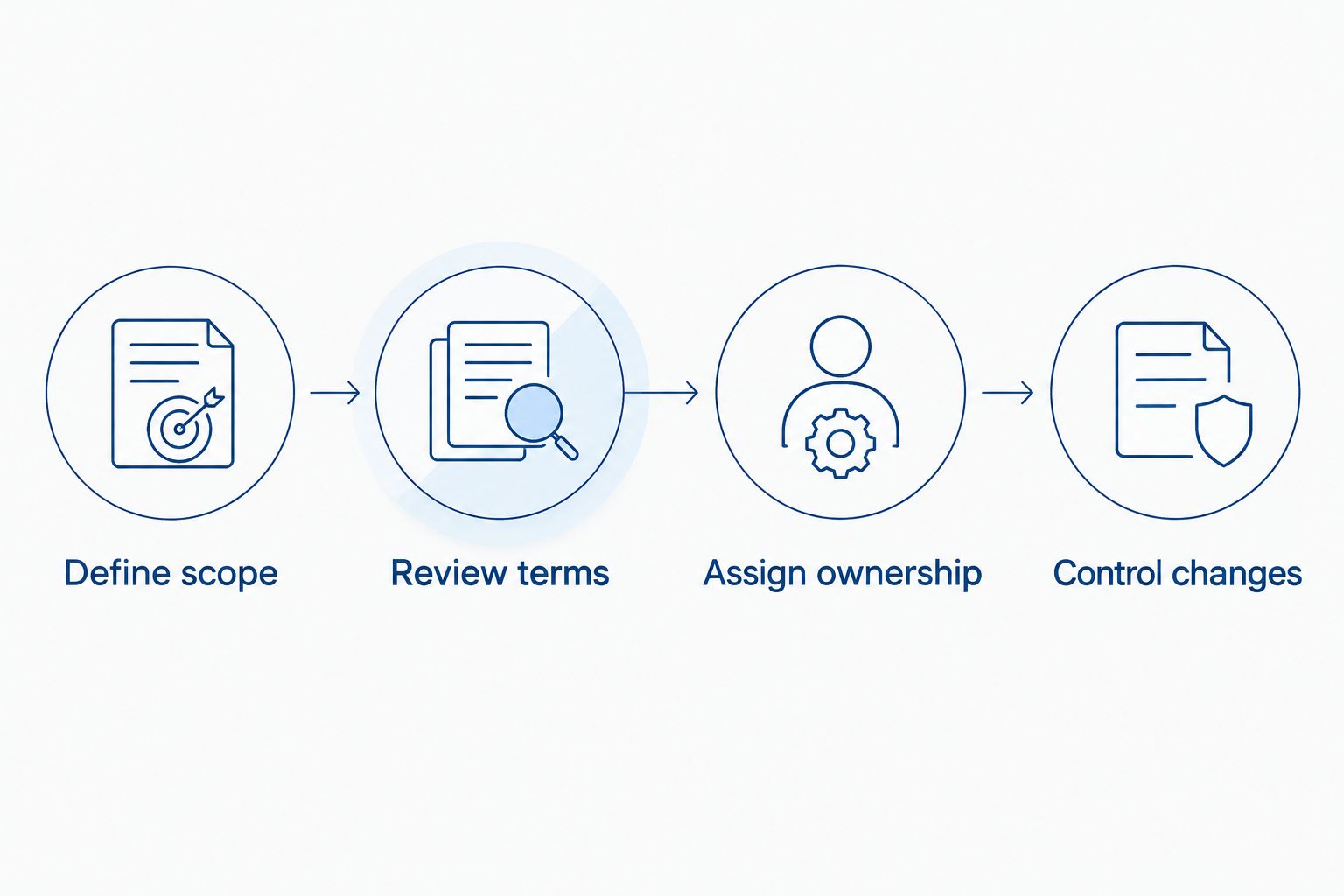
Turn the template into an agency operating rule
Do not stop at downloading a document. Use this recommended process to connect the agreement to delivery.
Define scope
Review 3 documents together: the proposal, the contract, and the statement of work. Check that they agree on deliverables, exclusions, approval responsibilities, and completion conditions. If information appears in more than one place, identify which document governs a conflict and have counsel review that structure.
Review terms
Use 2 review passes: commercial review by the people selling and delivering the work, then legal review by qualified counsel. Commercial review checks whether the agency can fulfill the promise. Legal review addresses how the agreement expresses and allocates obligations.
Assign ownership
Name 1 contract owner inside your agency. That person maintains the approved version, records negotiated departures, and directs questions to the right reviewer. Ownership is an operating responsibility, not permission to give legal advice.
Control changes
Define how additional work becomes an approved change. State who can authorize it and where that approval is recorded. Your delivery team needs an action to take when a request falls outside scope, not just a clause nobody remembers.
These are recommended workflow counts, not provider performance claims. The point is to make responsibility explicit before the next client engagement begins.
Which contract template provider should you choose?
Choose Rocket Lawyer as the default starting point when you need general document customization. Choose The Contract Shop when a specific creative-service template matches your engagement. Choose Bonsai for connected administration or PandaDoc for execution after the legal language is settled. Choose LegalZoom when the agreement is part of broader standard business-document work.
Agency Builders Membership is best for agency-owner peer learning and coaching, not sourcing legal contract templates. Use that distinction when choosing support: an operating question and a legal question need different answers.
Build stronger agency operating habits
Explore membership with coaching, masterminds, and in-person retreats for digital and creative agency owners.
FAQ
What's the best contract template provider for agencies in 2026?
Rocket Lawyer is the default starting point in this guide for customizable general business agreements. Choose a different provider when your main need is creative-service language, connected administration, or document-signing workflow, and get qualified review of the agreement.
Is The Contract Shop better than Rocket Lawyer for a creative agency?
The Contract Shop is the more targeted shortlist option when a specific creative-service template matches your engagement. Rocket Lawyer serves the broader need for customizable business documents; neither provider's name alone establishes that a document fits your agency.
Can PandaDoc replace an agency lawyer?
No. PandaDoc supports document templates and electronic-signature workflows, while a qualified lawyer advises on legal terms, jurisdiction, and the risks of your specific agreement.
Are Bonsai contracts enough for a growing agency?
A Bonsai contract should be assessed against the agency's actual services, obligations, and jurisdiction. Connected administration is useful, but growth introduces operational questions that a template alone does not answer.
Should an agency use a contract and a statement of work?
Use a structure that clearly separates governing terms from engagement-specific scope when that suits your work. Have counsel review how the documents interact, including which terms control if they conflict.
What should an agency contract say about extra revisions?
An agency contract should define the included revision scope and the approval process for additional work. Connect that language to a delivery procedure so the team knows when to stop and request authorization.
Does Agency Builders Membership provide legal contract templates?
Agency Builders Membership is described as a paid agency-owner community offering coaching, masterminds, and in-person retreats, not as a legal-template provider. Choose a legal-document provider and qualified counsel for contract drafting and review.
One last thing
Before sending your next agreement, ask the account manager and delivery lead to explain the scope boundary separately. If their answers differ, fix the operating definition before asking the client to sign.
A contract cannot make an undefined promise clear. Start with a scope your team understands, then choose the template and review process that express it accurately.