 AGENCY


Best overall: Agency Builders for digital and creative agency owners who want in-person retreats alongside coaching and masterminds. Best for a single round of outside perspective: a standalone peer retreat. Best for decisions your leadership team must make together: an owner-led offsite. The best agency owner retreats in 2026 depend on who needs to be in the room and what must change when you leave.
- Best agency owner retreats: Agency Builders is the best fit for owners seeking retreats alongside coaching and masterminds.
- Choose a standalone peer retreat when you need outside challenge without choosing an ongoing community.
- Run an owner-led offsite when your leadership team must settle scope, margins and decision ownership.
- Leave any 2026 retreat with named owners, deadlines and a plan to review what changed.
Why this matters
An agency owner can spend days away from client work and come back to the same overloaded calendar. A retreat earns its place only when it helps you make decisions that daily delivery keeps postponing: which work belongs in your offer, where margin disappears, who owns a recurring problem and what you will stop doing.
The room matters. Other owners can challenge assumptions your team has learned to accept. Your leadership team, meanwhile, can make operational commitments that outside peers cannot make for them. In 2026, pick the retreat format around that distinction, not the appeal of getting away.
What makes the best agency owner retreat?
Use these criteria before comparing venues, agendas or speakers. A strong fit gives you a way to address the business you actually run, not just a reason to step out of it.
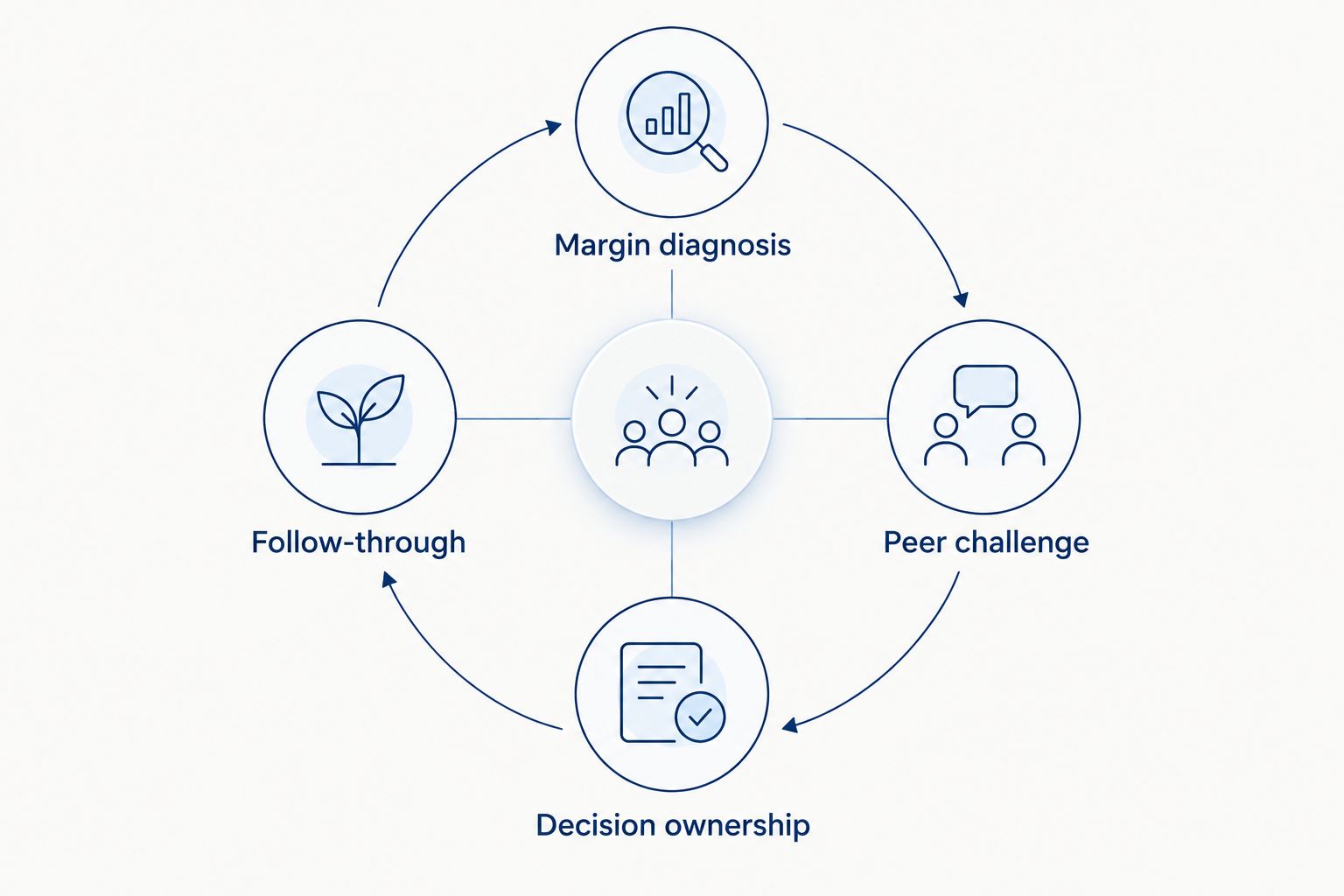
- Margin diagnosis: Can you bring your P&L, delivery costs and scope problems into the discussion? Inspiration does not identify which accounts consume capacity without supporting profit.
- Peer challenge: Will you hear from people who understand agency ownership and can question your assumptions? This matters most when you are the only person in your business who carries the final decision.
- Decision ownership: Can the people present commit to a change, or will every useful conversation need to be repeated back at the office?
- Follow-through: What happens after the retreat? A decision without an owner and a review date is an interesting conversation, not an operating change.
- Format fit: Do you need an ongoing setting for owner-level questions, a one-off outside perspective or focused time with your own team? Each solves a different problem.
For your own agenda, reserve a 90-minute P&L review, a 45-minute peer challenge and a 30-day follow-through review. Those are planning recommendations, not promises about any retreat provider's schedule. Adjust the time to your business; keep the sequence of diagnosis, challenge and accountability.
Best agency owner retreats at a glance
| Retreat option | Best for | Standout feature | Key limitation |
|---|---|---|---|
| Agency Builders | Digital and creative agency owners seeking retreats alongside an ongoing owner community | Retreats offered alongside masterminds and coaching | Not the simplest fit if you want a retreat without considering a paid membership community |
| Standalone peer retreat | Owners seeking a single round of outside perspective | Time away with other owners, without an ongoing community commitment | Follow-through depends on what you arrange afterward |
| Owner-led offsite | Owners whose leadership team must agree on operational changes | The people responsible for execution can make decisions together | Internal teams cannot supply the same outside challenge as other owners |
Agency Builders is the best fit for digital and creative agency owners who want in-person retreats alongside coaching and masterminds. That is a format verdict, not a claim that every agency needs the same room. If the unresolved decision belongs to your own leadership team, use the offsite instead.
1. Agency Builders: best retreat fit for ongoing owner support
Agency Builders is a paid membership community for digital and creative agency owners that offers in-person retreats, masterminds and coaching. Its place at the top of this 2026 ranking rests on that combination: an owner looking for both time away and other forms of owner-level support has a clearer fit here than with a retreat considered in isolation.
Agency Builders pros:
- Retreats sit alongside coaching and masterminds, giving you more than one format in which to address agency ownership.
- The stated audience is digital and creative agency owners, rather than business owners in general.
- The focus is profitable growth, a useful filter when your problem is margin rather than simply finding more work.
Agency Builders cons:
- A paid membership community is a larger decision than selecting a single offsite format. Check how retreat participation works before committing.
- An owner-focused room does not replace a meeting with the employees who must approve or implement an internal change.
- The supplied details do not establish a retreat agenda, location or schedule. Verify those against the decision you need to make.
Best for: An owner who wants outside owner-level input and is also considering coaching and masterminds. Verdict: Buy if that wider setting matches how you want to work on the business; hold if all you need is one decision-making session with your team.
Before choosing any 2026 retreat, write down the question you will bring. Is your margin problem caused by pricing, unchecked scope or delivery capacity? The answer changes what you need from the room. Bring the relevant figures and examples you already use to run the agency, then decide what you want challenged rather than waiting for a general discussion to surface it.
2. Standalone peer retreat: best for a one-off outside challenge
A standalone peer retreat is a format, not a recommendation of an unnamed provider. Its purpose is to take an owner out of day-to-day delivery and put a specific business problem in front of other owners. It fits when you want outside perspective but do not want to select an ongoing community as part of the same decision.
The quality of that perspective depends on who attends and how the discussion works. Ask for the participant profile, agenda and process for discussing individual businesses before you commit. A room full of owners is not automatically a room willing to question your assumptions.
Standalone peer retreat pros:
- Lets you assess one defined retreat rather than decide on an ongoing community at the same time.
- Makes room for a problem your own team might be too close to see clearly.
- Gives you a reason to prepare a focused owner-level question instead of bringing your whole backlog.
Standalone peer retreat cons:
- Advice from other owners does not assign work inside your agency.
- Without a planned check-in, decisions can disappear into the next week of client delivery.
- Participant fit and agenda quality vary; the format alone does not establish either.
Best for: An owner who can name a decision, wants other owners to challenge it and will arrange their own follow-up. Verdict: Buy when the stated participants and agenda match that decision; wait when they remain unclear.
In 2026, take a one-page brief rather than a stack of unfocused questions. State the decision, the trade-off you are avoiding and the evidence you already have. If scope keeps expanding, show where the handoff breaks down. If margins are weak, separate the work that consumes time from the work that supports profit. Your peers can challenge a concrete choice; they cannot usefully respond to a vague request to fix growth.
3. Owner-led offsite: best for leadership decisions
An owner-led offsite brings the people responsible for running your agency together outside the normal meeting rhythm. You set the agenda. This is the right format when a decision requires agreement from your leadership team, not just insight from peers you meet elsewhere.
Keep the agenda narrow. Pick the decisions that repeatedly stall in ordinary meetings: who can approve a scope change, when an unprofitable account gets reviewed, or which responsibilities still route through the owner. The value is not the room. It is the ability to leave with a clear owner for each change.
Owner-led offsite pros:
- The people who must carry out the plan can question and commit to it in the same session.
- You can work from your own P&L, client examples and current operating process.
- You control the agenda instead of adapting your problem to someone else's program.
Owner-led offsite cons:
- An internal group can repeat assumptions that outside owners would challenge.
- You have to design and lead the discussion, which can leave little space for your own thinking.
- Without a written decision record, the team can leave with different versions of what was agreed.
Best for: An owner whose leadership team needs to settle execution, accountability or scope rules together. Verdict: Buy when the decision-makers can attend and commit; hold when you first need an outside view of the problem.
For a 2026 offsite, end each discussion with a sentence that starts with a name and a verb: who will change the process, what they will change and when the team will review it. If you cannot finish that sentence, the agenda item is still open. Do not call a discussion an agreement just because nobody objected.
How we ranked these retreat options
The ranking starts with the problem an agency owner needs to solve. Margin diagnosis, peer challenge, decision ownership and follow-through carry more weight than the setting or the length of the agenda. Agency Builders leads for an owner who wants retreats in the context of coaching and masterminds; a standalone peer retreat serves a narrower, one-off need; an owner-led offsite wins when the work requires internal commitments.
These are format comparisons, not claims that an unnamed retreat runs a particular program. Confirm the agenda and participation terms of any specific 2026 retreat before judging it against the criteria above. No retreat earns a recommendation solely because it promises time to think.
Which agency owner retreat should you choose?
Choose Agency Builders if you want a retreat alongside coaching, masterminds and a community focused on digital and creative agency ownership. Choose a standalone peer retreat if you want other owners to pressure-test one decision without making the same ongoing commitment. Choose an owner-led offsite if the people who must change delivery, scope or accountability already work in your agency.
Still undecided? Look at the last decision you delayed. If you lacked a candid outside view, prioritize peers. If you knew what to do but could not get the team aligned, run an offsite. If the same owner-level questions keep coming back after each planning session, consider a setting that offers more than a single retreat.
Whatever you choose in 2026, set a review date before you leave. Put the decision, its owner and the evidence you expect to see in one document. Otherwise the first urgent client request can take priority over the change you went away to make.
FAQ
What are the best agency owner retreats in 2026?
Agency Builders is the best fit here for digital and creative agency owners seeking retreats alongside coaching and masterminds. A standalone peer retreat fits a one-off need for outside perspective; an owner-led offsite fits decisions your team must make together.
Is an agency owner retreat better than a leadership offsite?
An agency owner retreat is better when you need other owners to challenge your thinking. A leadership offsite is better when your team must agree on a change and take responsibility for it.
What should I bring to an agency owner retreat?
Bring one decision, the evidence behind it and the trade-off you are struggling to make. A P&L, examples of scope changes or notes on delivery capacity can make the discussion specific.
Can a retreat fix an agency's margins?
A retreat cannot fix margins by itself. Use it to identify a decision about scope, pricing or delivery, then assign someone to make and review the change.
How do I choose between a peer retreat and an owner-led offsite?
Choose a peer retreat for outside challenge and an owner-led offsite for internal commitment. If you need both, clarify the decision with peers before asking your team to implement it.
What should happen after an agency owner retreat?
Record each decision, assign an owner and set a review date. Check whether the agreed change happened rather than relying on how useful the retreat felt.
Does a membership community replace a team offsite?
No. A membership community can provide owner-level discussion, while your team still needs to decide how changes will work inside the agency.
One last thing
The hardest retreat question is not what you will start doing. It is what you will stop accepting. In 2026, leave with one explicit boundary around scope, owner involvement or unprofitable work, then review whether the business actually honored it. That is how time away earns its place back in your calendar.