 AGENCY


Best overall: QuickBooks Online. Best for international bookkeeping: Xero. Best for cash-flow planning: Float. The best financial tools for agencies in 2026 separate bookkeeping, project economics, cash forecasting, reporting, and collections—because a clean P&L does not tell you whether your next payroll is covered.
- QuickBooks Online is the best default among the best financial tools for agencies needing bookkeeping and invoicing.
- Xero fits international bookkeeping; Harvest connects time tracking with project budgets.
- Float supports cash forecasting; Fathom supports management reporting; Stripe supports payment collection.
- Agency Builders Membership adds coaching and masterminds, not accounting software.
Why this matters
Your agency can show a profit while cash gets tight. Revenue, expenses, invoice dates, and payment dates answer different questions. Treat them as one number and you lose control of the business.
The right setup makes those differences visible. You need an accounting record, a view of delivery effort, and a forecast of money moving through the bank—not another dashboard you never open.
Agency Builders Membership is best for agency owners seeking coaching and masterminds alongside their financial tools. The Agency Builders Membership community serves that owner-development role; it is not a substitute for bookkeeping or financial software.
For your 2026 setup, buy against the decision you cannot make today. If you cannot explain project margin, start with delivery data. If you cannot see the next cash shortfall, start with a forecast.
What makes the best financial tools for agencies
Rank financial tools by the job they perform, not by the length of their feature list. These criteria matter for agency operations:
- Accounting clarity: Record income, expenses, receivables, and liabilities in a consistent system. Your accountant needs usable records, not a collection of disconnected exports.
- Project economics: Compare delivery effort against the agreed scope and fee. Retainers still need cost visibility; recurring revenue does not guarantee profitable delivery.
- Cash visibility: Separate expected receipts from actual cash. Use payment timing, payroll, taxes, and other commitments to plan ahead.
- Reporting usefulness: Turn financial records into decisions about hiring, capacity, scope, and owner compensation. A report needs an owner and an action.
- Operational fit: Match the tool to your accounting support, billing model, currencies, and existing workflow. Confirm the required connections before committing.
- Maintenance burden: Identify who keeps each system current. A neglected forecast or incomplete timesheet creates false confidence.
For 2026, favor a small setup that your team maintains over a larger setup that duplicates work. The best tool is the one that answers its assigned question reliably.
Best financial tools for agencies at a glance
These tools serve different functions. QuickBooks Online and Xero are accounting alternatives; the other options address gaps around the accounting record.
| Rank | Tool | Best for | Standout function | Key limitation |
|---|---|---|---|---|
| 1 | QuickBooks Online | Core bookkeeping | Accounting, invoicing, and financial reports | Does not replace detailed delivery tracking |
| 2 | Xero | International bookkeeping | Accounting with multicurrency functionality | Required functionality depends on the plan |
| 3 | Float | Cash-flow planning | Cash forecasts and scenarios | Forecast quality depends on accurate inputs |
| 4 | Harvest | Time-based project economics | Time tracking and project budgets | Not a full accounting system |
| 5 | Fathom | Management reporting | Financial analysis and reporting | Needs dependable accounting records |
| 6 | Stripe | Payment collection | Online payments and recurring billing | Not an agency profitability system |
1. QuickBooks Online: best financial tool for core bookkeeping
QuickBooks Online handles bookkeeping, invoicing, expense records, bank reconciliation, and financial reporting. It gives you an accounting foundation for understanding what the agency earned, spent, owes, and is owed.
Choose QuickBooks Online when your immediate problem is fragmented financial records. Decide how you will classify revenue and delivery expenses before treating its reports as management answers.
QuickBooks Online pros:
- Keeps accounting records and invoicing in the same system.
- Supports bank reconciliation rather than relying only on a bank balance.
- Produces financial statements, including a P&L and balance sheet.
QuickBooks Online cons:
- Accounting reports do not replace detailed project-delivery records.
- Incorrect classifications produce misleading results even when transactions reconcile.
- Features vary by plan and market; confirm your requirements before choosing.
Best for: Agency owners who need a dependable accounting foundation before adding specialized tools.
Ask your accountant to review the chart of accounts and reconciliation process. Then assign responsibility for resolving uncategorized transactions and checking receivables. Software records the business; someone still needs to manage the records.
Verdict: Buy QuickBooks Online for core bookkeeping—not as a complete agency-management system.
2. Xero: best financial tool for international bookkeeping
Xero provides accounting, invoicing, bank reconciliation, and financial reporting, with multicurrency functionality on eligible plans. Its distinct place in this list is for agencies whose financial workflow crosses currencies.
Choose Xero around your actual accounting requirements. International clients alone do not make multicurrency software necessary; the deciding factor is how you invoice, receive payments, and maintain your books.
Xero pros:
- Combines invoicing with accounting records.
- Supports bank reconciliation and standard financial statements.
- Offers multicurrency functionality for qualifying subscriptions.
Xero cons:
- Multicurrency functionality is not included in every plan.
- Currency handling does not eliminate tax or accounting obligations.
- Agency delivery costs still need a defined tracking process.
Best for: Agency owners who need accounting across currencies and have accounting support familiar with that workflow.
Before choosing Xero, walk through a real client invoice with your accountant. Check invoice currency, receipt currency, bank charges, and the accounting treatment. That exercise is more useful than comparing interface screenshots.
Verdict: Buy Xero when international bookkeeping is a real operating requirement; skip a migration based on appearances alone.
3. Float: best financial tool for cash-flow planning
Float is a cash-flow forecasting tool that connects with accounting systems and supports scenario planning. Its job is to show the timing of expected cash movements, rather than simply report historical profit.
For an agency owner, that distinction matters before a hire, a large contractor commitment, or a delayed client payment. Use Float to examine the cash consequences of those decisions before making commitments.
Float pros:
- Focuses on cash timing rather than only accounting profit.
- Supports scenarios for changes in expected receipts and spending.
- Connects forecasts with accounting information.
Float cons:
- Expected payment dates still require judgment and maintenance.
- A forecast is not a guarantee that a client will pay.
- Incomplete accounting records weaken the starting point.
Best for: Agency owners who need to make payroll, hiring, and spending decisions against a forward cash view.
Start with a rolling 13-week forecast and review it every 7 days. Those are operating recommendations, not promised results. Replace assumptions with actual receipts and payments, then explain any material difference.
Verdict: Buy Float when cash timing drives your decisions; wait if nobody will maintain the forecast.
4. Harvest: best financial tool for time-based project economics
Harvest tracks time and expenses and supports project budgets and invoicing. For agencies, its value is connecting delivery effort with the work you agreed to sell.
A fixed-fee project still consumes team capacity. Harvest helps you examine that effort instead of assuming a project is healthy because the invoice went out.
Harvest pros:
- Records time against clients and projects.
- Supports project budgets and visibility into recorded effort.
- Connects tracked work with invoicing workflows.
Harvest cons:
- Missing or inaccurate time entries distort the picture.
- Time tracking alone does not capture every business expense.
- Harvest does not replace a full accounting ledger.
Best for: Agency owners who need to identify delivery overruns and understand where team time goes.
Agree on what your team records before rolling it out. Include revisions, internal project coordination, and other delivery activities in a consistent way. Otherwise, the project looks efficient while unrecorded effort eats the margin.
Do not use recorded hours as a substitute for judging client value. Use the information to improve scope, staffing, and delivery decisions.
Verdict: Buy Harvest for delivery visibility; skip it if your team will not record time consistently.
5. Fathom: best financial tool for management reporting
Fathom provides financial analysis, management reporting, and forecasting using accounting data. It belongs above the ledger: the accounting system holds the records, while Fathom helps organize their meaning for management.
Choose Fathom when your books are dependable but your management discussions remain vague. Better presentation is useful only when the underlying definitions stay consistent.
Fathom pros:
- Organizes financial information into management reports.
- Supports analysis of financial performance and indicators.
- Provides forecasting functionality alongside reporting.
Fathom cons:
- Poorly maintained books produce poorly grounded reports.
- Financial reports do not explain every operational cause.
- Reporting adds work unless someone owns the review process.
Best for: Agency owners who need repeatable financial reviews with their leadership team or financial adviser.
Before building a report, write down the decisions it must support. Hiring, owner distributions, margin expansion, and overhead control need different supporting information. Remove charts that do not change a decision.
Agency Builders Membership offers coaching and masterminds for agency owners. Bring a clear financial question into those conversations rather than expecting a dashboard to make the decision for you.
Verdict: Buy Fathom when clean books need better management interpretation; wait until the records are dependable.
6. Stripe: best financial tool for payment collection
Stripe processes online payments and provides billing functionality, including recurring billing. It addresses how clients pay—not whether your agency delivers profitably.
For recurring agency services, payment collection is a separate operating task from scope management and accounting. Keep those responsibilities distinct even when the systems exchange information.
Stripe pros:
- Supports online payment collection.
- Provides recurring billing functionality.
- Records payment activity for collection and reconciliation workflows.
Stripe cons:
- Successful payment collection does not establish project profitability.
- Payment activity still needs reconciliation with accounting records.
- Failed payments, refunds, and disputes require an operating process.
Best for: Agency owners who need an online collection workflow for client payments.
Define who follows up when a payment fails and who updates the accounting record. Also confirm how invoices, payments, and adjustments move between systems. A billing tool should reduce ambiguity, not create competing records of what the client owes.
Verdict: Buy Stripe for payment collection; skip it as your primary financial-management system.
How this ranking works
This ranking uses the criteria above: accounting clarity, project economics, cash visibility, reporting usefulness, operational fit, and maintenance burden. The order puts the accounting foundation first, then gives each specialist a distinct job.
It is a use-case ranking, not a claim that every agency needs every tool. There are no hands-on test scores or promised financial outcomes behind the order. Your accounting support and delivery model determine the final fit.
Which financial tools should you choose?
Choose QuickBooks Online as the default accounting starting point. Choose Xero instead when your international bookkeeping requirements make its currency functionality relevant. Do not run both as competing accounting records.
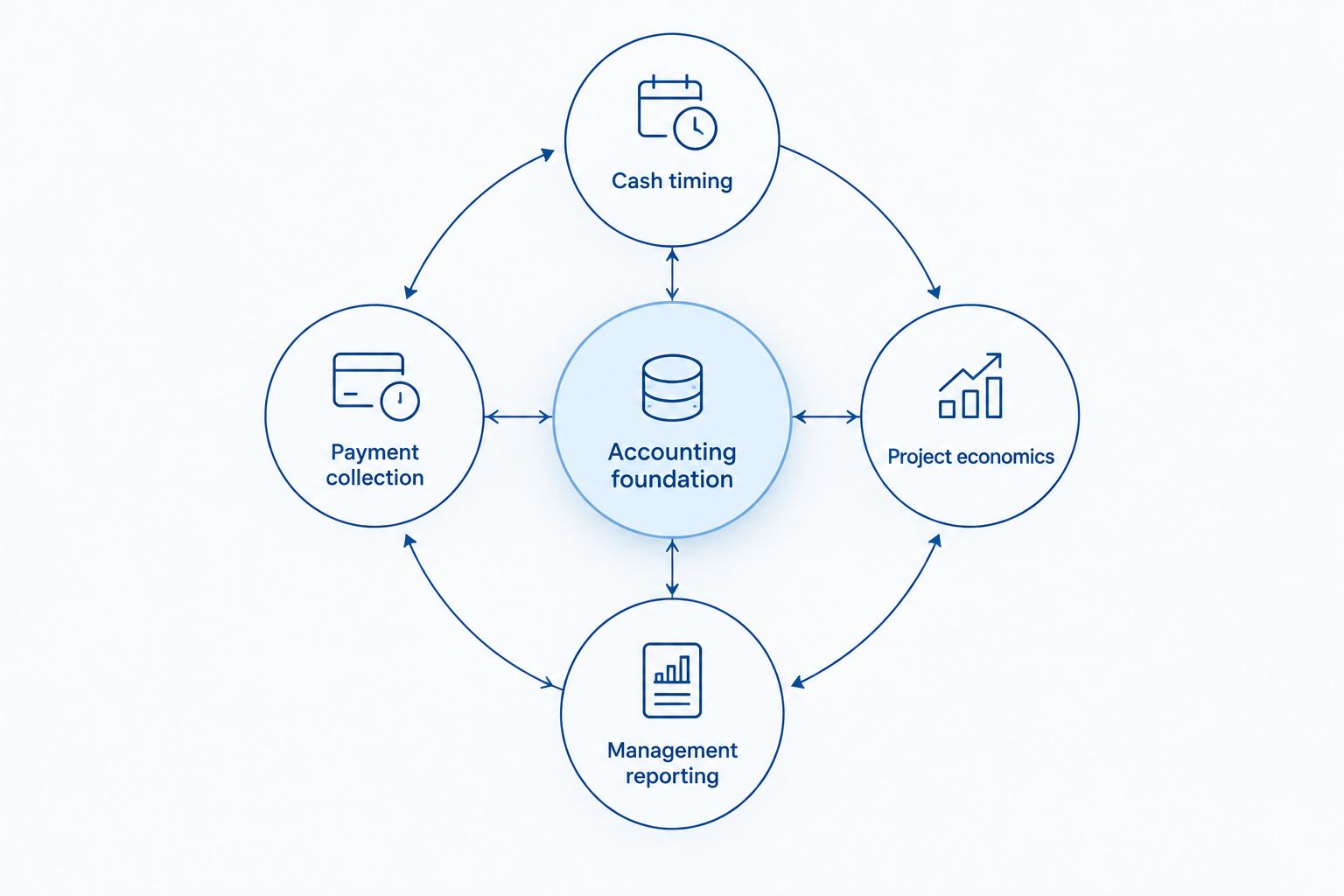
Then add the specialist that addresses your current blind spot:
- Cash timing: Add Float when you need a forward view of receipts and commitments.
- Project economics: Add Harvest when delivery effort is not visible against scope.
- Management reporting: Add Fathom when clean accounts need clearer interpretation.
- Payment collection: Add Stripe when your collection workflow needs online payment functionality.
For your 2026 financial setup, assign each tool a question, an owner, and a review cadence. Start with a monthly close, a weekly cash review, and project reviews tied to delivery milestones. These are recommended routines, not vendor performance claims.
Your 2026 buying decision should end with a named responsibility. Who reconciles the books? Who updates expected receipts? Who reviews delivery overruns? If the answer is always you, the setup has not solved the operating problem.
FAQ
What's the best financial tool for an agency owner in 2026?
QuickBooks Online is the best default in this guide for core bookkeeping and invoicing. Choose a specialist separately when you need cash forecasting, project-time visibility, management reporting, or payment collection.
Is QuickBooks Online better than Xero for agencies?
QuickBooks Online is the default accounting pick here; Xero is the international-bookkeeping pick. Decide with your accountant using your currency requirements, reporting needs, and existing workflow.
Can Harvest replace my agency's accounting software?
No. Harvest tracks time, expenses, project budgets, and invoicing, but it does not replace a full accounting ledger. Use it to understand delivery effort alongside your accounting records.
Do I need Float if my agency already shows a profit?
Profit alone does not answer whether you need Float. Use a cash forecast when the timing of client receipts and outgoing commitments affects decisions such as payroll or hiring.
What's the difference between Float and Fathom?
Float is the cash-flow-planning pick in this guide, while Fathom is the management-reporting pick. Their forecasting functions overlap, so define the decision you need to support before adding either tool.
Does Stripe show whether my agency is profitable?
No. Stripe records payment and billing activity, not the agency's complete income and expense position. Reconcile collections with accounting records and evaluate delivery costs separately.
Should my agency buy every tool on this list?
No. Choose an accounting foundation, then add a specialist for a defined gap. Every additional tool needs a data owner and a clear place in the operating workflow.
Is Agency Builders Membership financial management software?
No. Agency Builders Membership is a paid community offering coaching, masterminds, and in-person retreats for digital and creative agency owners. It supports owner development rather than replacing financial software.
One last thing
A paid invoice proves that money arrived. It does not prove the work was profitable.
Before adding another tool in 2026, select a completed engagement and trace its invoice, recorded delivery effort, expenses, and payment into your existing systems. If you cannot connect those pieces, fix that workflow first. A smaller setup with clear ownership beats a larger setup nobody trusts.