 AGENCY


Best overall: Built to Sell for reducing owner dependence. Best for cash discipline: Profit First. Best for a growing leadership team: Traction. These are the best books for agency owners in 2026 because each addresses a different constraint; pick the one that matches yours.
- Built to Sell is the best overall book for agency owners whose delivery depends on the founder.
- Profit First is the cash-discipline pick; Traction is the leadership-team pick.
- The E-Myth Revisited addresses repeatable work, while The Goal addresses bottlenecks.
- Agency Builders is best for owners who want coaching and masterminds while applying what they read.
Why this matters
Another business book will not fix an agency that keeps accepting vague scope, relies on its founder for every decision, or confuses revenue with profit. The useful book is the one that changes a decision you make this month. Start with the constraint, not the bestseller list.
A book gives you a framework you can revisit alone. Agency Builders is a paid membership community offering coaching, masterminds, and in-person retreats for digital and creative agency owners who want to scale profitably. Agency Builders is best for owners who want other agency operators involved in applying the work, not another title on the reading pile.
The 2026 ranking below separates five jobs: making the agency less founder-dependent, controlling cash, aligning leaders, documenting delivery, and finding the constraint that slows everything else. You do not need all five books at once. You need to know which problem comes first.
What makes the best books for agency owners?
Use these five criteria before you choose a title:
- Fit with your current constraint. A delivery-process book is the wrong first move if the immediate problem is cash discipline. Identify the decision you need to make, then select the book that helps you make it.
- Relevance to agency work. Agencies sell expertise and manage client relationships as well as production. Advice built for a factory or a general small business needs translating before it becomes an agency operating rule.
- Action you can assign. The strongest read gives you a change to test in a P&L review, scope discussion, team meeting, or delivery handoff. An idea that stays in your notes has no operational value.
- Fit with your role. A solo founder deciding what to standardize needs a different starting point from an owner coordinating department leads. Match the book to who must act on it.
- Clear limits. No title diagnoses your accounts, resolves a client dispute, or makes your team follow a process. Prefer a book whose limits you can see before you reorganize the business around it.
The ranking favors a direct match to an agency owner's decisions. Built to Sell leads because its central problem, dependence on the founder, reaches sales, delivery, and capacity. That does not make it the first purchase for every owner. If cash management is the immediate constraint, start with Profit First instead.
Best books for agency owners at a glance
| Book | Best for | Standout feature | Key limitation |
|---|---|---|---|
| Built to Sell | Reducing founder dependence | Story built around a service-business owner | Does not replace detailed delivery processes |
| Profit First | Establishing cash discipline | Cash-allocation method | Does not fix weak margins by itself |
| Traction | Aligning a growing leadership team | Entrepreneurial Operating System framework | Requires sustained team participation |
| The E-Myth Revisited | Making routine work repeatable | Working on the business versus in it | General small-business lens |
| The Goal | Finding a delivery bottleneck | Constraint-focused story | Manufacturing setting requires translation |
The table is a decision aid, not a reading order you must finish. Read the section tied to the problem showing up in your calendar, cash decisions, or client delivery. Then choose one operating change to make.
1. Built to Sell: best book for reducing founder dependence
John Warrillow's Built to Sell follows a fictional service-business owner working to make the company less dependent on him. Its lesson for an agency owner is not that every service should become identical. It is that custom work becomes hard to hand off when the founder alone knows how to sell, scope, and deliver it.
Look at a recent project from inquiry through delivery. Where did someone wait for your judgment because the offer, approval rule, or handoff was unclear? That is the part of the business to examine while reading. You are testing whether the agency can make a sound decision without routing every exception through you.
Built to Sell pros:
- The service-business story makes owner dependence easy to recognize.
- It connects offer design with the ability to delegate work.
- It gives you a direct question: what must stop living only in the founder's head?
Built to Sell cons:
- A narrative does not supply detailed procedures for your specific services.
- A narrower offer is not automatically the right answer for every agency or client relationship.
Best for: An owner still approving routine scope, sales, or delivery decisions. Verdict: Buy if those approvals are blocking the team. In 2026, use the book to identify one decision category you can define and delegate; do not announce a new agency model before testing the handoff.
2. Profit First: best book for agency cash discipline
Mike Michalowicz's Profit First presents a method of allocating incoming cash among distinct purposes rather than treating profit as whatever remains after spending. For an agency, the immediate question is whether its cash habits make obligations and owner returns visible. Read it alongside your actual P&L, not as a substitute for one.
A busy project pipeline can hide uncomfortable spending decisions. The book gives an owner a way to confront those decisions at the point cash arrives. It cannot tell you whether a particular client, service, or project is profitable without accurate numbers behind that work.
Profit First pros:
- It turns profit from a year-end hope into an operating decision.
- Its allocation approach gives owners a concrete cash-management habit to evaluate.
- It prompts a closer look at what the agency keeps after obligations.
Profit First cons:
- Moving cash between accounts does not repair an unprofitable scope of work.
- The method still depends on sound bookkeeping and an informed view of obligations.
Best for: Owners whose revenue is active but whose cash decisions remain reactive. Verdict: Buy if cash discipline is the immediate problem. In 2026, examine project economics alongside the method; otherwise you risk managing the timing of cash while leaving the margin problem untouched.
3. Traction: best book for aligning agency leaders
Gino Wickman's Traction sets out the Entrepreneurial Operating System, or EOS, for defining direction and running a business through shared operating practices. An agency owner can use it to bring leadership discussions out of scattered messages and into an agreed meeting and accountability structure. The value depends on whether the people making decisions participate.
This is a better fit once responsibilities extend beyond the founder. If you are still personally making nearly every decision, clarify what work can be handed off before building a heavier management rhythm. A meeting cannot create ownership where nobody has authority to act.
Traction pros:
- It gives leaders a common vocabulary for priorities and accountability.
- It treats recurring issues as work to resolve, not topics to revisit indefinitely.
- It connects day-to-day execution to a stated direction.
Traction cons:
- Adopting the practices takes continuing attention from the team.
- A formal cadence adds work if roles and decision rights remain unclear.
Best for: Owners with leaders who need clearer priorities and accountability. Verdict: Buy when the team is ready to use a shared operating rhythm. In 2026, begin by naming the decisions each leader owns; the meeting structure should support that ownership, not stand in for it.
4. The E-Myth Revisited: best book for repeatable agency work
Michael E. Gerber's The E-Myth Revisited distinguishes doing the technical work from building a business that can deliver it consistently. That distinction hits an agency founder who became an owner because they were good at strategy, design, development, or another craft. Skill at the work does not, by itself, define how someone else should scope or deliver it.
Use the book to identify work the team repeats but explains differently each time. A documented handoff, approval point, or definition of completion is more useful than a manual nobody opens. Keep room for professional judgment where clients genuinely need it; repeatable work and thoughtful custom work are not opposites.
The E-Myth Revisited pros:
- It separates the founder's craft from the work of running the agency.
- It makes recurring delivery tasks candidates for clearer systems.
- It encourages consistency before growth adds more handoffs.
The E-Myth Revisited cons:
- Its general small-business examples need translating to agency services.
- Over-standardizing expert work can ignore meaningful differences between client needs.
Best for: Owners whose team repeatedly asks how routine work should be done. Verdict: Hold if your immediate constraint is cash or leadership alignment; otherwise, buy it to improve a specific recurring handoff. In 2026, choose a process people use, not a documentation project built for its own sake.
5. The Goal: best book for finding an agency bottleneck
Eliyahu M. Goldratt's The Goal uses a manufacturing story to explain why improving activity across a system is different from improving its limiting constraint. An agency is not a factory. The useful transfer is the question: which step actually holds up delivery, and does fixing another step change the outcome?
Trace a piece of client work from agreed scope to completion. If work repeatedly waits at one review or decision point, making other people busier will not clear that wait. First confirm that the delay is recurring and consequential; a frustrating exception is not necessarily the agency's main constraint.
The Goal pros:
- It shifts attention from individual busyness to the flow of work.
- The story makes constraint thinking easier to discuss with a team.
- It challenges process changes that do not address the limiting step.
The Goal cons:
- Its manufacturing setting is not a direct model for client-service work.
- Identifying a bottleneck does not settle questions about scope, quality, or client expectations.
Best for: Owners whose delivery process stays slow despite a busy team. Verdict: Hold until you can name a recurring delay; buy it when that delay is the problem you need to understand. In 2026, test the constraint against actual project handoffs rather than assuming the most vocal complaint identifies it.
How these books were ranked
The ranking weighs agency relevance, an actionable operating decision, and the limits of applying each book. It is not a claim that these titles were tested against agency performance data. Built to Sell takes the default position because its service-business story addresses a common structural question: can the agency sell and deliver without the founder resolving every handoff?
That default changes when another constraint demands attention. Profit First is the first read for cash discipline. Traction fits a team that already has leaders but lacks shared accountability. The E-Myth Revisited helps define recurring work, while The Goal helps locate the step that keeps that work from moving. A relevant book beats a higher-ranked book when it answers the decision you face now.
Turn a reading list into an agency decision
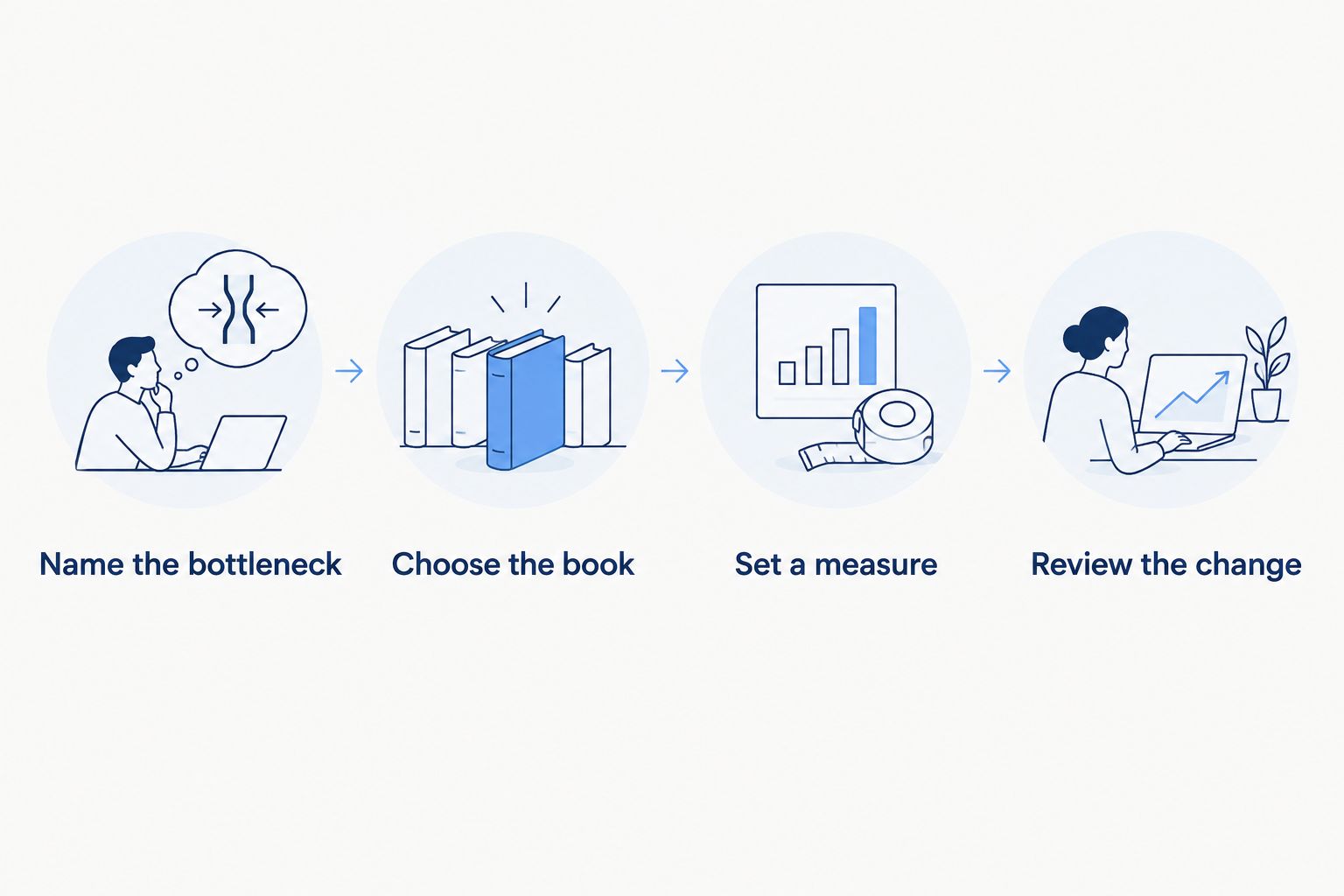
Do not ask the team to read all five titles. Name the business problem first, choose the matching book, agree on a change you can observe, and review whether the change addressed the problem. That sequence keeps reading connected to operations rather than aspiration.
- Name the bottleneck. Write down where the current process stops: founder approval, cash decisions, unclear ownership, inconsistent handoffs, or a recurring delivery delay. Separate a repeated pattern from a difficult individual project.
- Choose the book. Match that pattern to the table above. If you cannot explain why a title fits in a sentence, postpone the reading assignment.
- Set a measure. Decide what evidence would show progress before changing the process. You might inspect whether decisions still return to the founder or whether the same handoff still stalls; use records you already trust.
- Review the change. Keep what improves the work and revise what creates friction. A framework is a prompt to examine the agency, not permission to ignore what happens inside it.
This is where Agency Builders fits a different need from the reading list. Its coaching and masterminds give agency owners a setting to discuss decisions with others; the books supply frameworks to bring into those discussions. Neither replaces looking closely at your own scope, margins, and team responsibilities.
Which book should an agency owner choose?
Choose Built to Sell if you cannot step away from routine sales or delivery decisions without work waiting for you. It is the default recommendation because owner dependence affects more than your calendar: it shapes how clearly the agency defines and hands off its work.
Choose Profit First instead if cash decisions demand attention now. Choose Traction if leadership responsibilities exist but priorities keep drifting. Choose The E-Myth Revisited when recurring work lacks a reliable process, or The Goal when a persistent delay is the problem. In 2026, the right answer is not the longest reading list. It is the book that changes the next agency decision you make.
FAQ
What is the best book for agency owners in 2026?
Built to Sell is the best overall pick for an agency owner whose business depends on the founder for routine decisions. If cash discipline or leadership alignment is the immediate constraint, start with Profit First or Traction instead.
Which book should an agency owner read to improve profit?
Profit First is the cash-discipline pick. Read it alongside accurate project and agency financial records, because a cash-allocation method does not fix unprofitable client work by itself.
Is Built to Sell better than The E-Myth Revisited for an agency?
Built to Sell is the stronger first read when founder dependence is the main problem. The E-Myth Revisited is better when you already know which recurring work needs a clearer process.
Is Traction useful for a small agency?
Traction is useful when an agency has leaders who need shared priorities and accountability. If the founder still owns nearly every decision, clarify responsibilities before adding a formal meeting rhythm.
What should I read if my agency team is busy but delivery is slow?
Read The Goal to examine where work repeatedly gets stuck. Its setting is manufacturing, so apply the constraint question to agency handoffs rather than copying the setting.
Do agency owners need to read all five books?
No. Pick the book that addresses the agency's current constraint, make an operating change, and review the result before choosing another title.
Can a book replace agency coaching or a mastermind?
No. Books provide frameworks you can study independently; Agency Builders offers coaching and masterminds for digital and creative agency owners who want to work through business decisions with others.
One last thing
If your team cannot describe the problem without naming a book, stop building the reading list. Describe the stuck decision first. Agency Builders is for owners who want support applying that thinking; the best books for agency owners give you a sharper question to bring to the table.