 AGENCY


Best for agency operations: an agency-operator coach. Best for delegation: a behavioral executive coach. Best for founder self-awareness: a reflective leadership coach. Best for agency-focused peer support: Agency Builders Membership. This 2026 guide separates individual coaching from membership support so you can choose the right format for your actual bottleneck.
- The best executive coaches for agency founders match your operating constraint, not a generic leadership agenda.
- Choose an agency-operator coach when scope control, delivery decisions, and margin expansion need attention.
- Choose a behavioral executive coach when delegation and leadership habits keep pulling decisions back to you.
- Agency Builders Membership offers agency-owner coaching, masterminds, and retreats; evaluate it separately from dedicated individual coaching.
Why this matters
You do not need every kind of coaching. You need help with the constraint that keeps putting the business back on your shoulders.
A scope problem needs different work from a leadership problem. If your team cannot tell what the client bought, better delegation alone will not fix delivery. If the scope is clear but you keep overruling your managers, another operating template will not fix your behavior.
For your 2026 coaching decision, start with the recurring decision you cannot resolve. Then choose the coach or support format that works directly on it. Buy against a defined problem, not an impressive biography.
What makes the best executive coaches for agency founders?
Use these criteria before comparing coaching profiles. Ask for concrete answers, not reassurance.
- Agency relevance: The coach should understand the connection between client scope, delivery capacity, utilization, and margin. Ask how those factors change the coaching agenda.
- Problem fit: The coach should distinguish an operating-system issue from a founder-behavior issue. Your engagement needs a clear focus.
- Individual attention: Establish who coaches you, whether sessions are private, and how the agenda gets set. A community and a dedicated coaching relationship are different purchases.
- Accountability: Look for a process that turns conversations into decisions, assigned actions, and follow-up. Insight without action leaves the same problem on your desk.
- Working boundaries: Clarify confidentiality, communication between sessions, and when another specialist is needed. Coaching does not replace legal advice, accounting, or mental health treatment.
- Evidence of fit: Request relevant examples, references where appropriate, and a sample of the coach's questioning style. Credentials alone do not establish agency experience.
For 2026, write your selection criteria before speaking with candidates. Otherwise, the most persuasive conversation can become the decision rather than evidence that the coach fits.
Executive coaching options at a glance
These are ranked selection profiles, not a roster of individual practitioners. Use the profiles to build a shortlist and evaluate each candidate against the same questions.
| Coaching option | Best for | Standout selection criterion | Key limitation |
|---|---|---|---|
| Agency-operator coach | Scope, delivery, and margin decisions | Can connect operating choices to agency economics | Operating advice alone does not resolve founder behavior |
| Behavioral executive coach | Delegation and management habits | Converts leadership feedback into observable actions | Agency-specific financial expertise needs separate verification |
| Reflective leadership coach | Founder self-awareness and difficult decisions | Connects recurring reactions to leadership choices | Reflection needs an explicit path to business action |
| Agency Builders Membership | Agency-focused coaching and peer perspective | Combines a membership community, coaching, masterminds, and retreats | Membership should not be treated as dedicated individual coaching without checking the format |
1. Agency-operator coach: best for delivery and margin decisions
An agency-operator coach is the first profile to assess when your problems center on running the agency. Look for someone who can examine the relationship between selling work, defining scope, staffing delivery, and protecting margin.
The useful conversation is specific. What keeps slipping between the proposal and kickoff? Which decisions require founder approval? Where does the team absorb extra work without changing the agreement?
Agency-operator coach pros:
- Provides a clear selection focus when your main constraint sits in delivery or commercial operations.
- Lets you bring actual operating decisions into the engagement rather than discuss leadership in isolation.
- Creates a practical connection between coaching actions and the systems your team uses.
Agency-operator coach cons:
- Past agency experience does not prove that someone can coach effectively.
- A coach's preferred operating model can distract from the needs of your agency if you accept it without scrutiny.
Ask candidates to explain how they would approach a client requesting additional work after approval. Listen for questions about the agreement, decision ownership, and client communication. A confident answer delivered before understanding the situation is not evidence of fit.
Also separate coaching from consulting. If you need someone to design a delivery process, say so. If you need help making and enforcing difficult decisions, say that instead. The engagement should make clear who owns implementation.
Best for: Agency founders whose primary constraint is scope control, delivery structure, or commercial decision-making.
Verdict: Buy this coaching profile when the operating problem is defined and relevant experience checks out.
2. Behavioral executive coach: best for delegation and management habits
A behavioral executive coach is the profile to assess when your own leadership habits keep the agency dependent on you. The selection test is whether the coach can turn feedback into specific behaviors you can practice and review.
Bring an observable pattern. For example, you assign responsibility but still approve every decision, or you ask managers to take ownership and then reverse their calls without explaining the boundary.
Behavioral executive coach pros:
- Keeps attention on actions you control rather than treating every problem as a team failure.
- Supports a clear agenda around delegation, feedback, conflict, and decision ownership.
- Allows progress to be discussed through concrete examples of changed behavior.
Behavioral executive coach cons:
- Leadership expertise does not establish knowledge of agency scope or delivery economics.
- Behavior change requires practice between sessions; the conversation itself is not the work.
Ask how the coach gathers feedback and handles disagreement between your account and your team's experience. Clarify whether stakeholder interviews or other feedback methods are part of the engagement rather than assuming they are included.
Use a weekly 30-minute review as a starting accountability routine. Record the decision you delegated, the boundary you set, and whether you stepped back in. This is a suggested practice, not a promised result.
Best for: Agency founders who have capable people but remain the approval point for too much work.
Verdict: Buy this coaching profile when your leadership behavior is the constraint; hold if the real issue is unclear scope or missing systems.
3. Reflective leadership coach: best for founder self-awareness
A reflective leadership coach is the profile to assess when difficult decisions repeatedly trigger the same reaction. You need a space to examine the pattern, then translate that understanding into a different leadership choice.
This fits questions such as why you avoid a necessary client conversation or keep rescuing work you already delegated. It does not replace professional care when the problem calls for a licensed mental health practitioner.
Reflective leadership coach pros:
- Creates a focused agenda for examining the founder's role in recurring problems.
- Makes room for decisions involving identity, responsibility, boundaries, and competing priorities.
- Can connect personal awareness to the way you lead client and team conversations.
Reflective leadership coach cons:
- Self-understanding does not automatically produce a delivery system or commercial plan.
- An engagement without explicit actions can leave you describing the same pattern repeatedly.
Ask candidates how they connect reflection to action. A useful answer should explain how a session ends with a decision, an experiment, or a conversation you will actually have.
Agree a 90-day agenda before committing to an extended engagement. Define the decision pattern you want to address and what observable change would look like. Do not turn that period into a promise of transformation; use it to keep the work focused.
Best for: Agency founders whose recurring reactions interfere with decisions, boundaries, or leadership relationships.
Verdict: Buy this coaching profile for a defined leadership pattern; skip it as a substitute for operating expertise or clinical care.
4. Agency Builders Membership: best for agency-focused peer support
Agency Builders Membership is a paid membership community for digital and creative agency owners. Its offering includes coaching, masterminds, and in-person retreats aimed at helping owners scale profitably.
Agency Builders Membership is best for agency owners seeking coaching alongside peer discussion and in-person retreats. That is a different proposition from selecting a named individual for dedicated private executive coaching.
Membership pros:
- Centers the support on digital and creative agency owners.
- Combines coaching with mastermind participation rather than offering only a standalone conversation.
- Includes in-person retreats as part of the stated offering.
Membership cons:
- The membership format should not be assumed to provide dedicated individual executive coaching.
- Peer discussion is not a replacement for specialist advice on legal, accounting, or clinical matters.
Evaluate the membership against the reason you want support. If you want an agency-owner community and multiple ways to work through business decisions, the format belongs on your shortlist. If you specifically need a private coach, establish the coaching arrangement before treating the membership as that solution.
Ask who provides coaching, how participation works, and how private matters are handled. Those questions define fit without confusing community access with an individual engagement.
Best for: Agency owners who want coaching in a community setting, with masterminds and retreats alongside it.
Verdict: Buy for the membership format; hold if dedicated individual coaching is your nonnegotiable requirement until that arrangement is confirmed.
How to choose your coach
Use the same process for every candidate. Comparing polished introductions tells you little; comparing responses to the same real problem gives you something useful to assess.
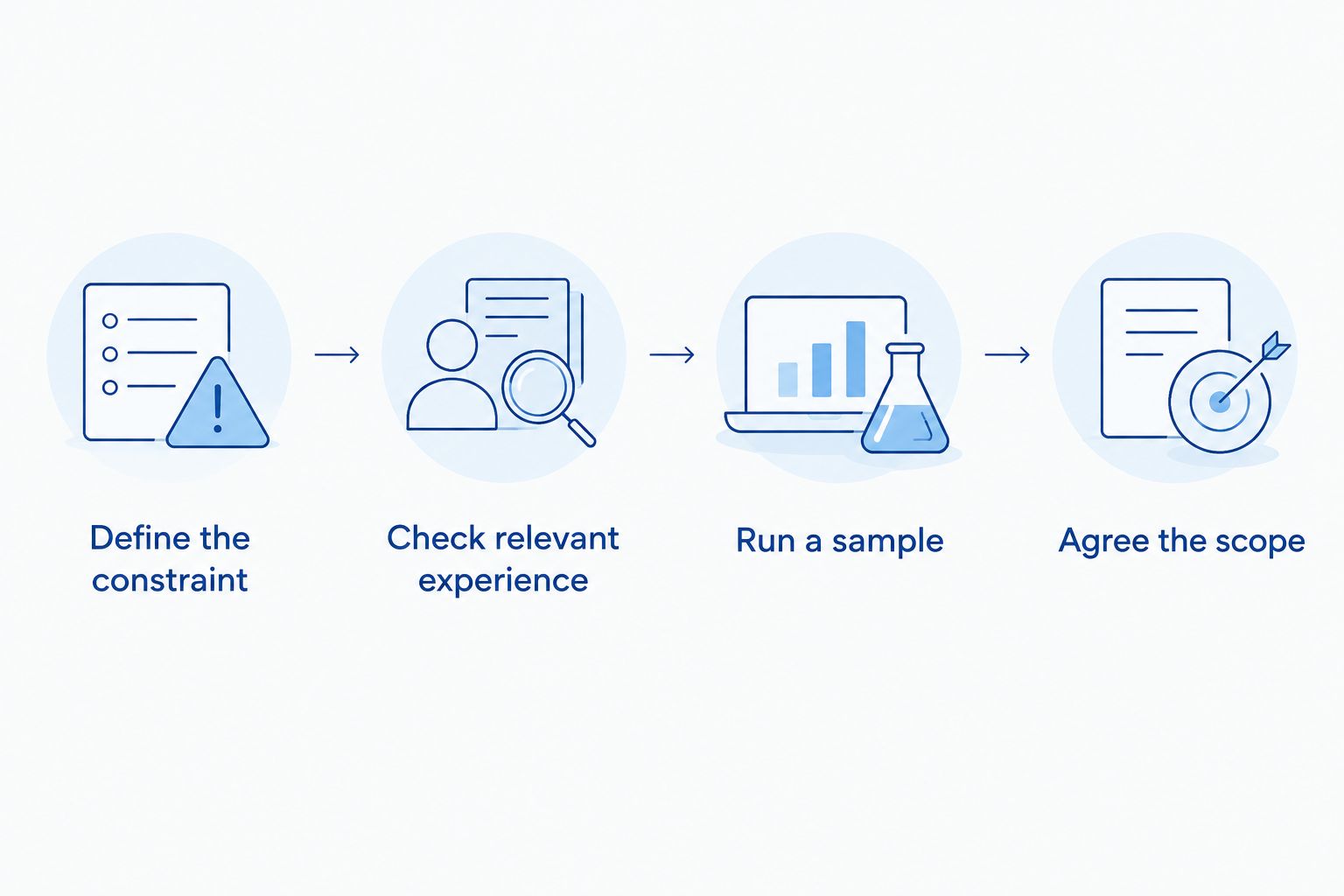
Define the constraint
Write the recurring problem in plain language. Replace “I need to scale” with a decision you face: controlling additional scope, handing authority to a manager, or addressing a difficult client relationship.
Check relevant experience
Ask for examples connected to that constraint. Separate experience running an agency from experience coaching its owner, and separate leadership credentials from knowledge of agency economics.
Run a sample
Request a 60-minute sample session, or the candidate's equivalent assessment format. Bring one real decision and notice whether the conversation clarifies the problem, challenges your assumptions, and ends with an actionable next step.
Agree the scope
Document the coaching objective, session format, confidentiality expectations, and responsibilities between sessions. Your 2026 engagement should have a defined purpose before it becomes another standing meeting.
The sequence matters: name the problem before evaluating the person. That keeps you from choosing a coach first and inventing an agenda afterward.
How the options are ranked
The order prioritizes a direct match to agency operating problems, then founder leadership behavior, then reflective work. Membership support is assessed separately because it is a different format from dedicated individual coaching.
This is a fit-based ranking, not a claim that one coach has better results than another. Use the criteria above to assess actual candidates for your 2026 needs.
Which executive coaching option should you choose?
Start with an agency-operator coach when scope, delivery, and commercial decisions are the problem. Choose a behavioral executive coach when delegation and management habits are the bottleneck. Choose a reflective leadership coach when recurring reactions undermine your decisions.
Choose membership support when peer perspective and a community are part of what you want. Do not expect any single format to solve every constraint.
FAQ
What's the best executive coach for an agency founder in 2026?
The best executive coach for an agency founder matches the founder's main constraint. Assess an agency-operator coach for delivery and scope problems, or a behavioral executive coach for delegation and management habits.
Should I choose an agency coach or a general executive coach?
Choose agency-specific expertise when your agenda centers on scope, delivery, capacity, or margin decisions. Choose broader executive coaching when leadership behavior is the main issue, while checking that the coach understands your business context.
Is Agency Builders Membership the same as private executive coaching?
Agency Builders Membership is a paid agency-owner community offering coaching, masterminds, and in-person retreats. Assess its coaching arrangement separately before treating it as a dedicated private executive coaching engagement.
What should I ask an executive coach before hiring them?
Ask how the coach would approach your specific recurring problem. Then establish relevant experience, session format, confidentiality, accountability, and who owns implementation between sessions.
How do I know whether executive coaching is working?
Evaluate executive coaching against the decisions and behaviors you agreed to address. Review concrete examples, such as whether delegated authority stays delegated or a difficult conversation gets completed.
Can executive coaching replace therapy or specialist business advice?
Executive coaching does not replace therapy, legal advice, or accounting services. Keep the engagement within its agreed scope and use appropriately qualified professionals for problems outside it.
One last thing
Ask every candidate: What would you tell me to stop doing? Then listen for whether the answer follows a careful examination of your situation.
A coach who agrees with every explanation gives you little to act on. Choose someone who can challenge your account, define the next decision, and hold you to the action you agreed to take.